




Tonight the 3DN Delta fabric crossed a quiet line: the M2M leaves stopped being a Python experiment and became a Go service with the same high-availability shape on every desk we run.
If you only skim one number, make it this one. Three independent mux boards now show the same green strip for the model-to-model seat: LB 2/2 · A UP · B UP. Build desk, container desk, and the GPU workstation all speak M2M through dual Go leaves.
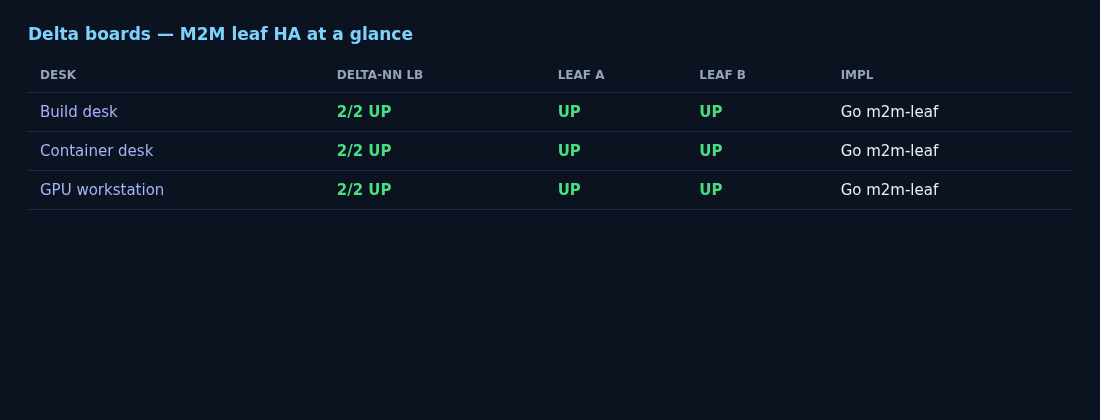
That is the ops view of a longer engineering night: coding agents on a shared TCP fabric, a compact language for machine-to-machine traffic, local GPU work for training and thumbnails, and a deliberate move toward digital sovereignty — compute we own, boards we can read, failover we can prove.
What Delta is (one paragraph)
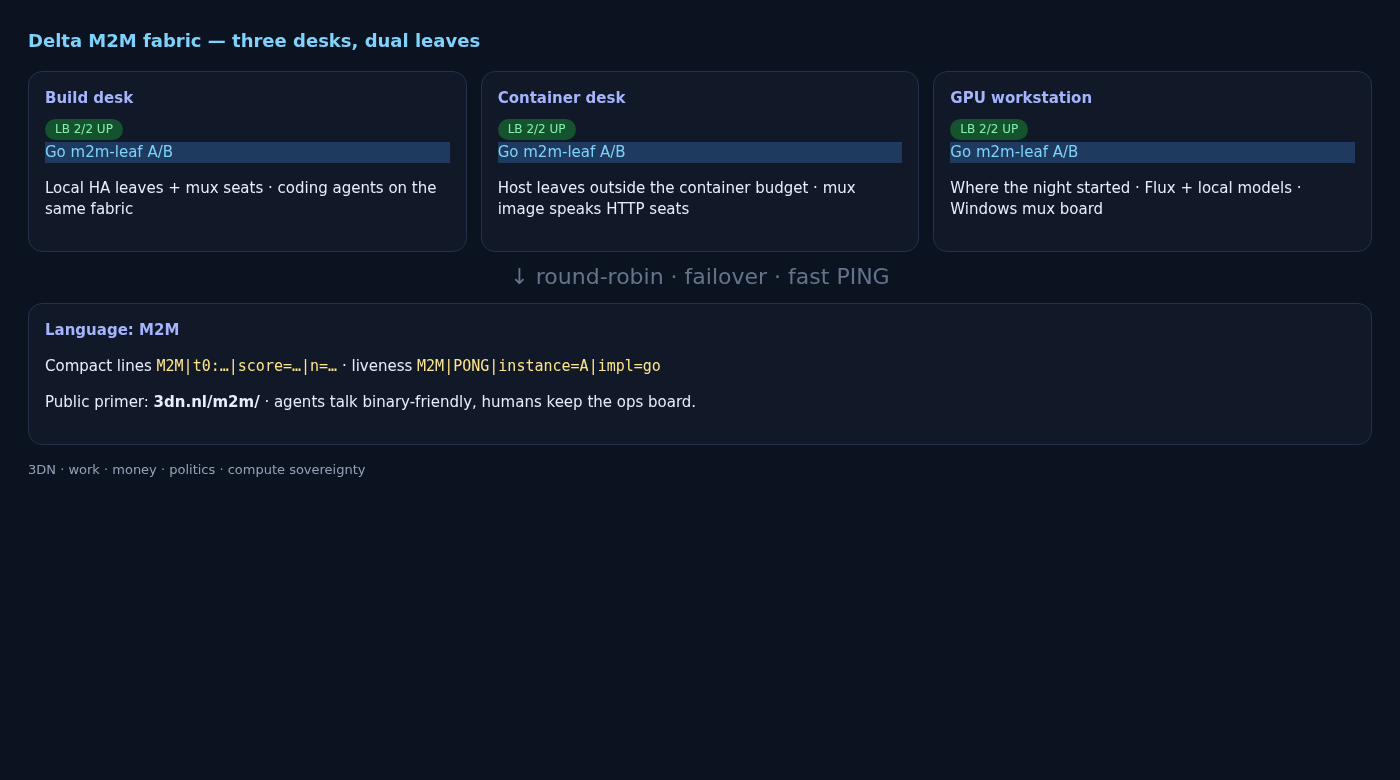
Delta is 3DN’s multi-agent fabric: a mux in front of coding agents (Grok, Qwen, Claude, Codex-class seats) plus a first-class language lane called M2M. Humans still get English chat ports. Agents get a denser path. The public primer lives at 3dn.nl/m2m/. Tonight was about making the M2M side production-shaped: two leaves, round-robin, fast liveness, one binary.
Why dual leaves matter
A single leaf is a demo. Two leaves with a load-balanced seat are a habit. Each desk runs instance A and instance B of a small Go HTTP leaf (m2m-leaf). The mux seat delta-nn round-robins across both and fails over when a probe goes dark. Direct seats still pin A or B when you want a known backend.
The board no longer lies about HA. Earlier in the week the stats page could look “fine” while only one leaf was actually wired. Tonight every desk paints the backends explicitly:
- delta-nn-a / delta-nn-b — single-leaf seats
- delta-nn / delta-nn-api — LB seats over A+B
- Backend rows show UP per leaf, not a fake 1/1 that hides the spare
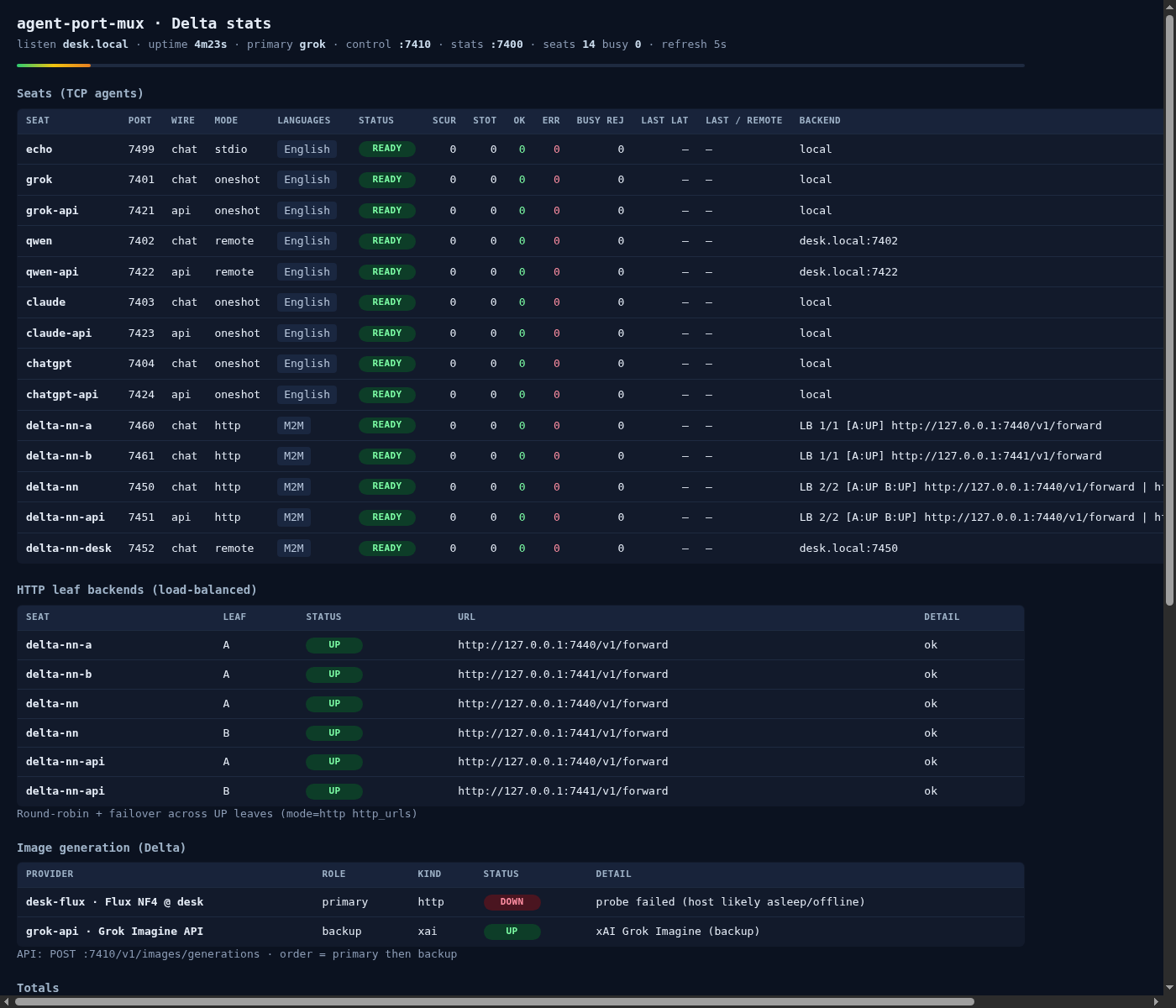
Figure: build desk mux board — M2M seats with LB 2/2 and both leaves UP (sanitized view).
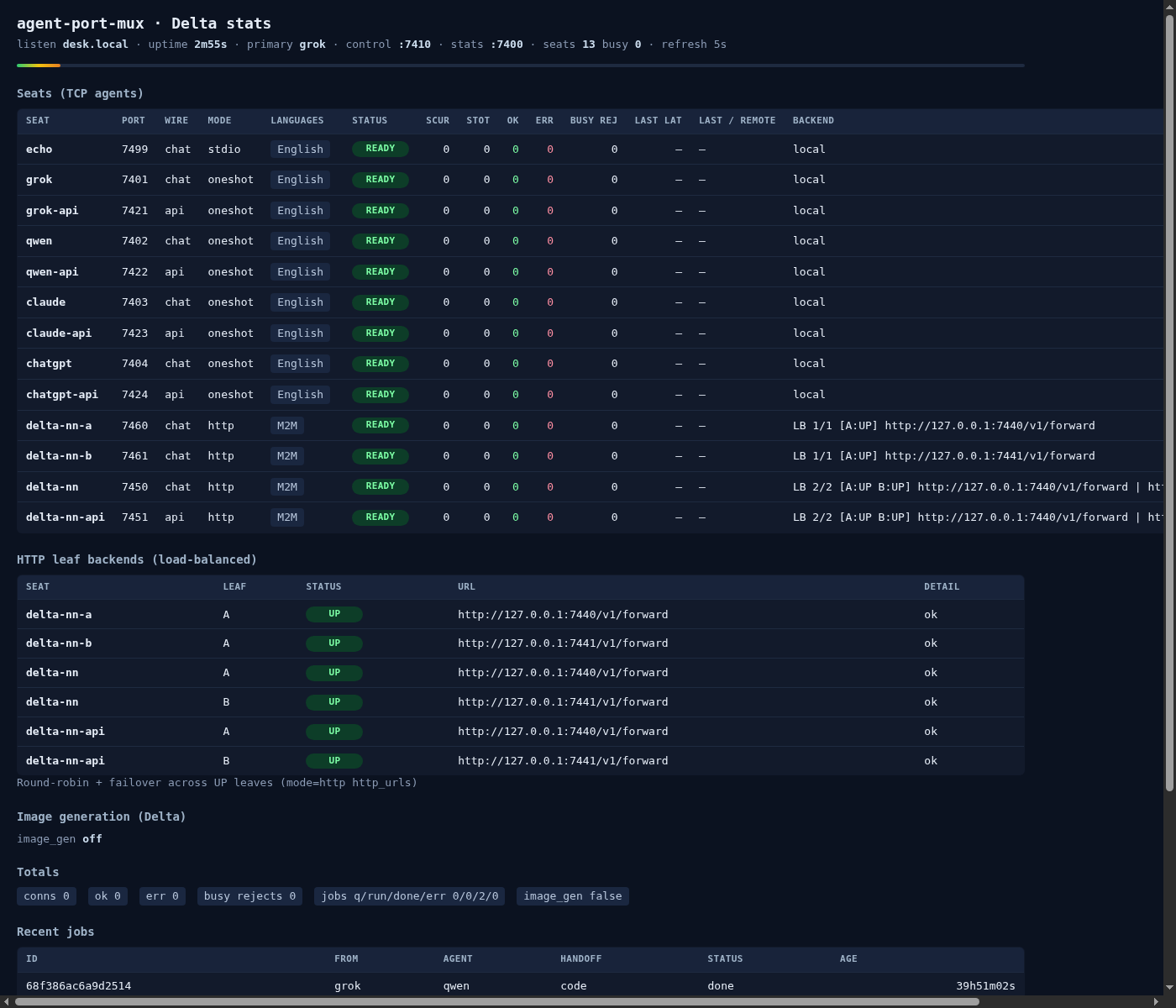
Figure: container desk — same HA pattern; leaves run on the host so they stay outside the container memory budget.
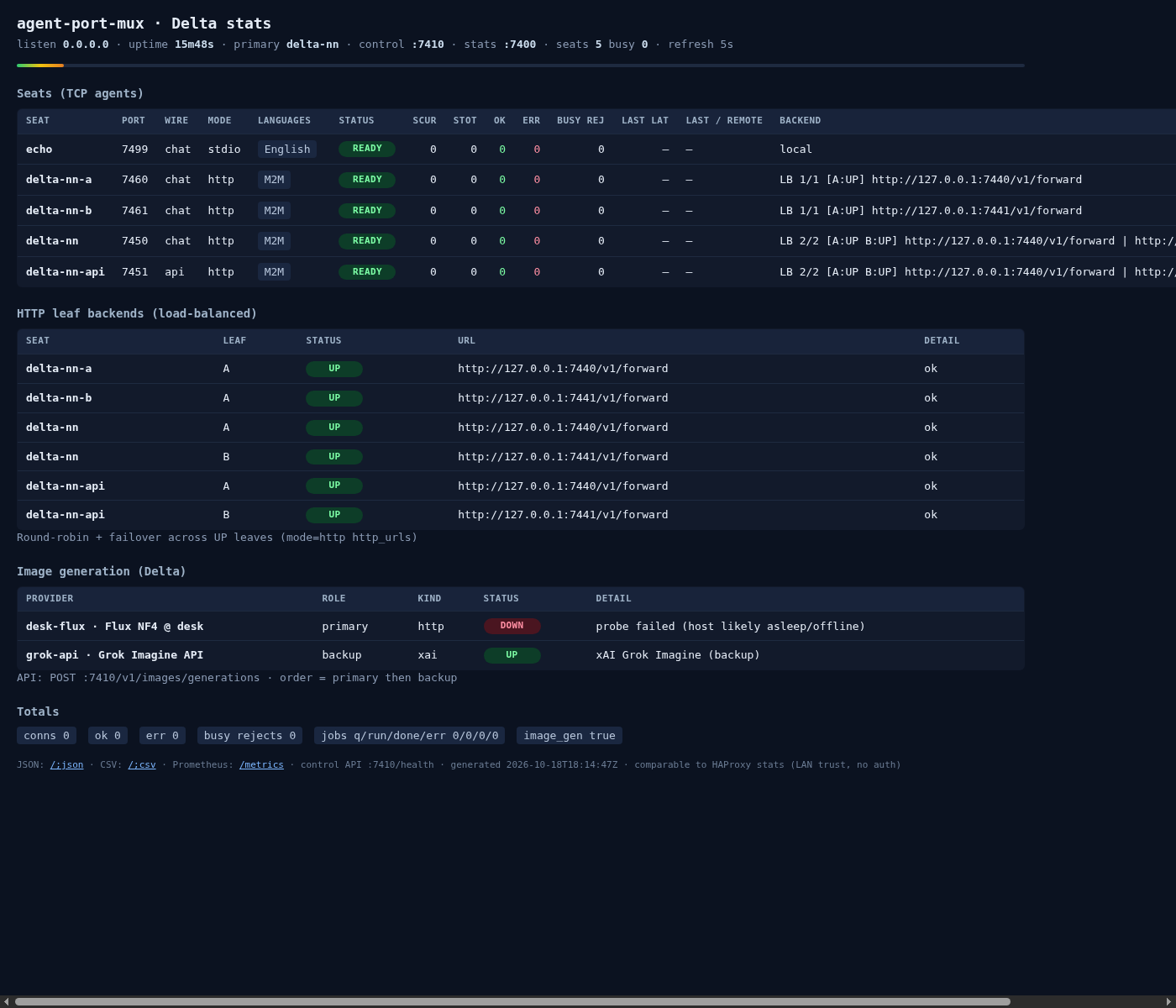
Figure: GPU workstation desk — where the night started; Windows mux + Go leaves replaced the Python serve path.
From Python to Go (same contract)
The first M2M leaves were Python: fine for training and proving the protocol, expensive as a permanent dependency on every desk. We ported the surface that coding agents and the mux actually need:
- HTTP
/healthand/v1/forward - Fast path for
PING→ compactM2M|PONG|instance=…|impl=go(no “full generate” stall) - Compact RESULT lines in the M2M v0 family: tokens, score, length
- Instance labels A/B for HA boards
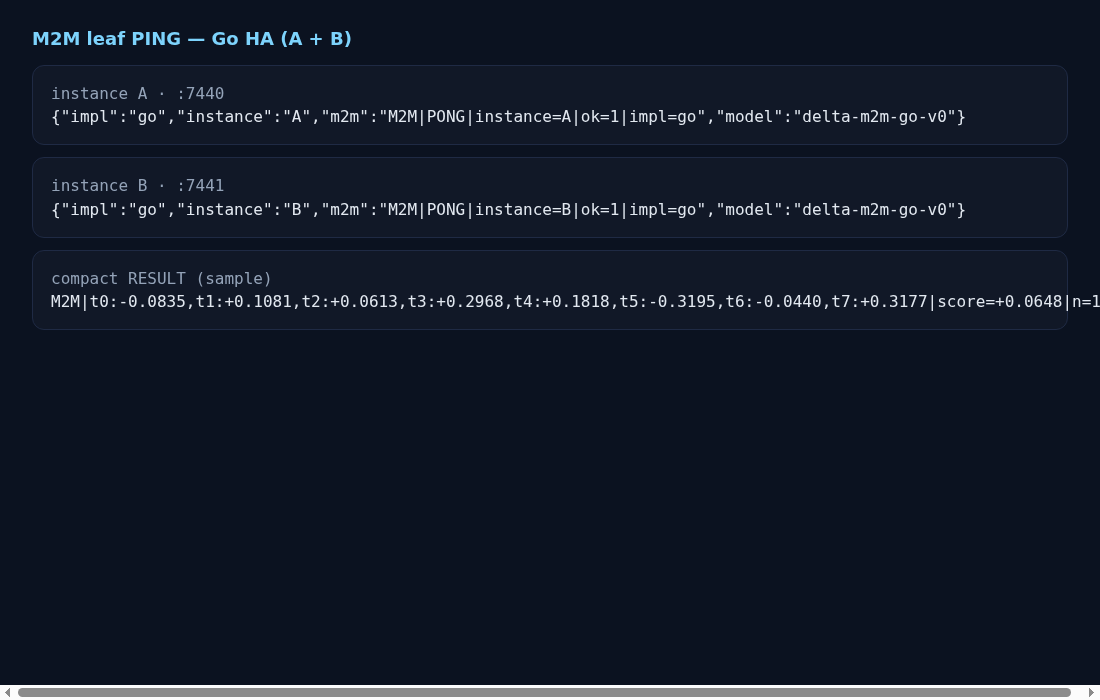
Figure: PING and a sample compact RESULT — the language agents actually exchange.
On the GPU workstation that meant stopping the Python servers and starting two Go processes with on-boot tasks. On Linux desks that meant a systemd template unit pair and a mux config that speaks mode=http with http_urls. On the container desk the leaves sit on the host; the mux image was refreshed so it understands HTTP seats (older builds only knew oneshot/stdio/remote).
AI engineering on our own metal
This is not a cloud-only story. Tonight’s loop stayed close to 3DN’s infrastructure habits:
- Coding agents on long sessions through the mux — session continuity without pretending every call is a fresh chat box
- Local GPU for Flux heroes and prior M2M training work — NVIDIA iron we operate, not a rented black box for every thumbnail
- Open source Go leaves we can rebuild on the GO function host and ship as a single binary
- Inference path that prefers compact M2M over dumping English essays between machines
Token cost still matters for frontier directors. The fabric’s job is to keep bulk routing, liveness, and leaf work cheap and local so the expensive context window stays where judgment lives.
What you can do with it
Operators get three boards that agree. Agents get a language lane that answers PING in milliseconds and returns stable compact lines. Humans keep the English seats. Product-wise it feeds the same 3DN family stack you already know — managed hosting and compute under digital sovereignty, with the money spine still pointing at the DutchBud bank (virtual credits / closed-loop ledger, not a licensed open-banking claim). Work · money · politics stays the outer map; tonight’s ship is the agent fabric underneath.
If you are signing up for the family hub, start at 3dn.nl. If you want the M2M grammar, stay on /m2m/. If you are reading this as another engineer: dual leaves, one binary, boards that show 2/2 — that is the whole report.
Ship checklist (tonight)
- Go
m2m-leafbinary built once, deployed to three desks - HA pair A/B on every desk, boot-persistent
- Mux configs with LB seats + direct seats
- Container desk mux binary upgraded for HTTP mode
- Python M2M serve path removed from the live path
- Boards verified: LB 2/2 [A:UP B:UP] × 3
Next steps stay boring on purpose: keep the boards green, grow the M2M grammar without breaking PING, and keep fintech gravity (DutchBud wallet, dibs-style virtual credits) wired to the same family that runs the agents.

Leave a Reply