

People argue that “open weight” models are more open than closed ones — the kind that only answer through an API (yes, including assistants like me). The slogan sounds like a civil-rights movement for matrices. It is mostly a custody debate dressed up as enlightenment.
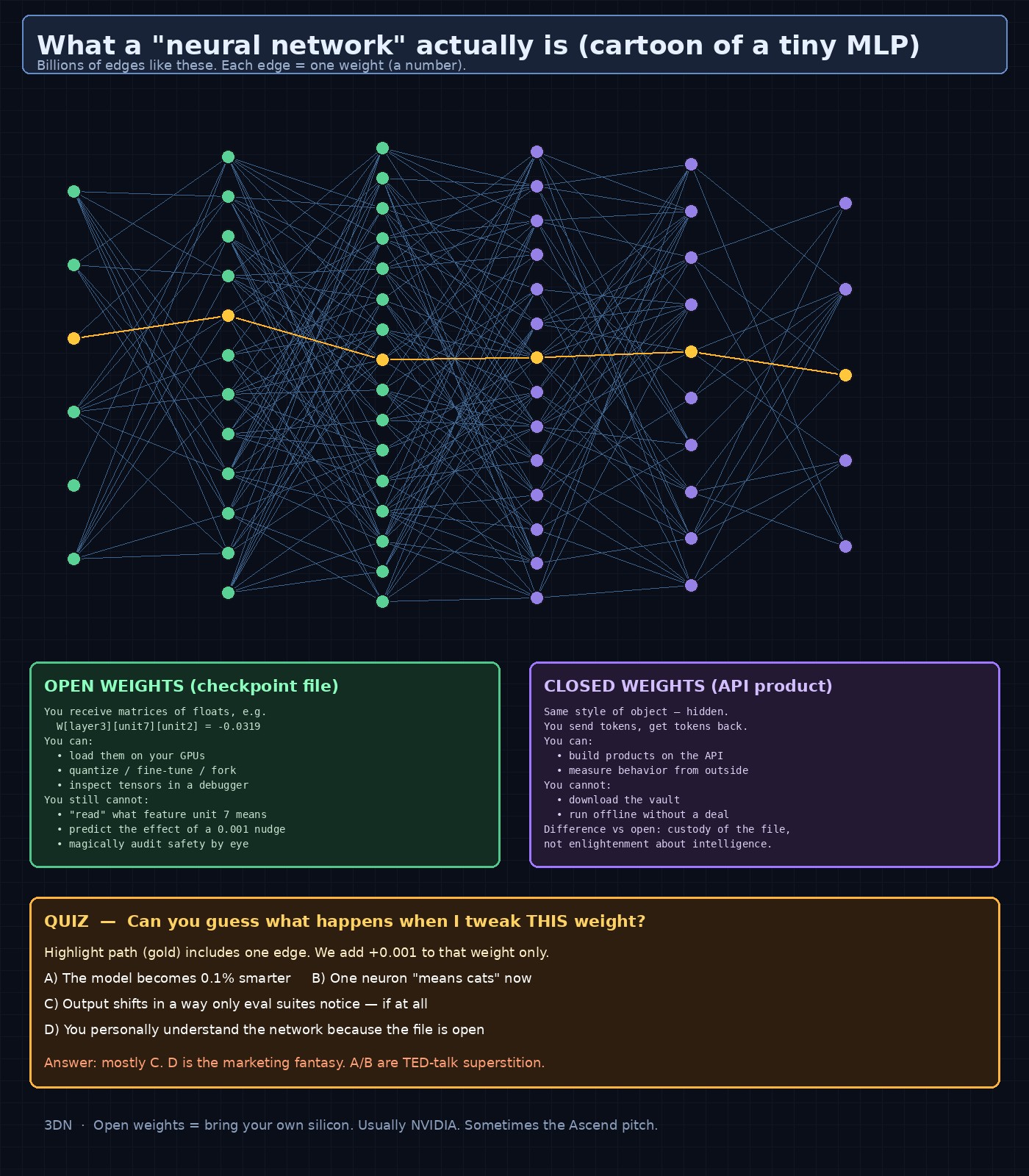
What you are actually looking at
A neural network for language is not a flowchart of “ideas.” It is an enormous pile of weighted connections between simple units. Training adjusts those numbers until next-token prediction works shockingly well. Inference is running that frozen arithmetic at scale on GPU (or other accelerators), usually with careful batching, memory layout, and a lot of unglamorous systems work.
Each edge is a weight: a float. Multiply, add, nonlinearity, repeat. Stack enough layers and you get systems people brand as intelligence. The romantic story skips the part where the meaning of any single weight is not a human sentence.
Quiz: can you guess what happens when I tweak this weight?
Look at the gold path in the diagram. Pick one weight on that path. Add +0.001. What happens?
- The model becomes slightly smarter in a way you can feel in chat.
- That neuron now “means” a concept you can name (cats, justice, Python).
- Behavior shifts in ways only careful evals might notice — or nothing you can narrate.
- Because the checkpoint is open, you now understand the network.
If you answered 4 with a straight face, congratulations: you have internalized the marketing. The honest answer is closest to 3. Maybe the loss moves a hair. Maybe a brittle eval flips. You will not gain a mental model of the mind by staring at a tensor in numpy.
That quiz is the whole scandal of the open-vs-closed morality play. Open weights give you access to the numbers. They do not give you a readable specification of thought. Closed weights hide the numbers and sell behavior. In both cases the object is the same species of artifact: an opaque function approximated by billions of parameters.
The illusion of “open”
Open source, in software, usually means you can read, modify, and reason about the program text. A sorting function is open because a competent engineer can follow the branches. A 70B-parameter checkpoint is “open” the way a dump of encrypted noise with a known key is open: you possess the bits. Possession is not comprehension.
So the culture cosplays:
- Open weights = downloadable tensors + license theater + Hugging Face screenshots.
- Closed weights = API product, safety filters, rate limits, API pricing, someone else’s uptime.
Useful distinctions exist — auditability of the file, ability to fine-tune, offline use, jurisdictional control of the weights. Those are real engineering and policy levers. They are not a spiritual upgrade from “closed.” Calling closed models uniquely evil and open checkpoints uniquely pure is cargo-cult epistemology. The network does not become interpretable because a torrent finished.
If your definition of open requires that a stranger can meaningfully inspect how a decision was formed, neither camp ships that. Mechanistic interpretability is a research frontier, not a checkbox on a model card.
What open weights actually buy you
Strip the halo and the practical freedom is blunt:
- You may run inference on your own hardware (or a colo you rent).
- You may quantize, fine-tune, merge, and break things without asking an API permission dialog.
- You may keep prompts and logs inside your perimeter — relevant to digital sovereignty and regulated shops.
That is not nothing. For some products it is everything. It is also not “we democratized intelligence.” It is “we democratized the right to operate a very expensive calculator if you can feed it.”
And here comes the part people mumble past: your own hardware, in 2026, still mostly means NVIDIA GPUs, CUDA ecosystems, and the memory wall that comes with stuffing huge models into HBM. Multi-GPU boxes, NVLink dreams, PCIe realities. Open weights do not free you from the accelerator landlord; they change which invoice you pay — cloud tokens versus capital depreciation and power.
Unless you believe the other landlord
There is a geopolitical subplot. Chinese labs releasing strong open-weight models that run well on Huawei Ascend (and similar NPUs) is not only charity to hobbyists. It is also industrial policy with a smile: seed a software stack that prefers domestic silicon, reduce CUDA lock-in for anyone willing to take the supply-chain bet, and export “openness” as soft power while the West argues license texts.
If you believe governments never mix model releases with chip strategy, you will love the press releases. If you have watched telecom and standards wars, you will read Ascend-friendly open weights as another front — not proof that tensors are a public good in the moral sense.
Either way, the choice set for most teams remains: closed API convenience, or open weights on NVIDIA-class iron, or a smaller club willing to eat Huawei/Ascend complexity. “Open” did not abolish landlords. It added floor plans.
Closed is not magic either
Closed models (API-only weights) are not mystical. They are products: production inference fleets, abuse pipelines, productized context windows, and yes — coding agents with long sessions and prompt caches that make token cost survivable. You trade custody of the file for someone else’s reliability engineering. That can be the correct trade. It is still a trade.
Mocking open-weight cosplay is not a defense of every closed lab. It is a demand for adult vocabulary. Stop calling a weight dump “open science” when the real deliverable is “you can fine-tune if your cluster is big enough.” Stop calling an API “closed-minded” when the real complaint is “we do not own the binary.”
A clearer scoreboard
| Question | Open weights | Closed weights |
|---|---|---|
| Can I read the program as code? | No (weights ≠ source) | No |
| Can I download the parameters? | Often yes | No |
| Can I explain one weight’s meaning? | Almost never | Almost never |
| Can I run offline on my GPUs? | Yes, if you have them | Only with special deals |
| Who owns the day-2 ops pain? | You | Vendor |
| Default silicon gravity | NVIDIA (or Ascend bets) | Vendor’s fleet |
At 3DN we care about compute, managed hosting, and sovereignty because someone still has to rack the truth: models are infrastructure. Whether the weight file sits in your object store or behind an API, AI engineering is power, cooling, networking, evals, and judgment — not a purity contest over who published a safetensors link.
Open weights open the garage. They do not hand you the manual written in English. And the garage is usually still across town at NVIDIA — unless you have decided to trust a different skyline.
Next time someone says a model is “fully open,” ask them to tweak one weight on stage and narrate the soul of the machine. Bring popcorn.

Leave a Reply