

3DN vision — recorded 11 August 2026, sealed for 11 August 2031. This is a bet about civilizational compute: who may train, who may refuse a supply chain, and who still owns the shopping list. Not the next gadget. Not a roadmap slide.
3DN works in managed hosting, infrastructure, and digital sovereignty. We already live the small version — coding agents, long sessions, GPUs that wait. Nations run the same physics with louder budgets. So we write the claim down without incense, then the mechanism, then the receipts. Throw it back in our face in five years.
I. The bet (no fog)
By 11 August 2031:
- The main path for frontier and near-frontier training and inference inside China does not depend on smuggled NVIDIA boards plus SK Hynix / Samsung HBM.
- On-package / 3D memory is a funded national program with deployed racks — treated the way the West treated EUV: existential, not a keynote.
- Open-weight models are trained and served as native citizens of that stack. Boring, not a demo.
- A visible tier of national-scale machines exists: near-memory packages, extreme cooling, a unified scale-up fabric. Not merely export SKUs.
- Two durable AI hardware–software stacks, not one NVIDIA monoculture. Dual stacks already exist (TPU, Trainium, custom ASICs). The claim is that China’s stack trains frontier without begging the old cartels.
If in 2031 the main path still critically depends on smuggled Western HBM and banned boards, this vision failed. If the main path is sovereign silicon + memory + package + open weights, it held.
II. The shopping list was the border
They blocked the easy path: advanced NVIDIA GPUs and the lithography romance associated with ASML. From the outside it looked like a corner. From inside a long state, it can look like a furnace.
When you cannot buy the default future, you stop rehearsing someone else’s roadmap. Gadget makers chase SKUs. Civilizations chase capability that a license cannot revoke. Ascend-class silicon that stays mostly domestic is not a marketing failure. It is a feature of strategy.
The heavier constraint is not a sad priest of shrink. It is scanners, process kits, EDA, and packaging yield. Tooling denial — EUV, parts of DUV, high-NA — is the real wall around the old religion of the nanometer. Taiwan / TSMC remains the single point of failure the West still pretends is a vendor preference. A vision about civilizational compute that skips that sentence is not serious.
III. We bought a storm and fed it through a straw
For two decades the winners of the old game were almost unfairly good at gaming-class GPUs — silicon as spectacle, then as data-center destiny — and at the scoreboard of shrink. Those are real miracles. They are an incomplete gospel when the prize is who trains the models that reorder industry and power.
Peak FLOPS look holy on a slide. In the rack, a brutal fraction of that GPU power sits idle, waiting on bits that live too far away. Anyone who has watched serious multi-GPU training and inference knows the confession in the utilization chart: we bought a storm and fed it through a straw.
That idle silicon is not a gadget QA bug. It is a strategic leak: watts and capital burned while the real race is memory locality, packaging, and the right to keep running when imports stop. The memory wall is the scoreboard. The accelerator is not lazy. It is stranded.
IV. Mechanism: wall, package, heat, fabric, energy, compiler
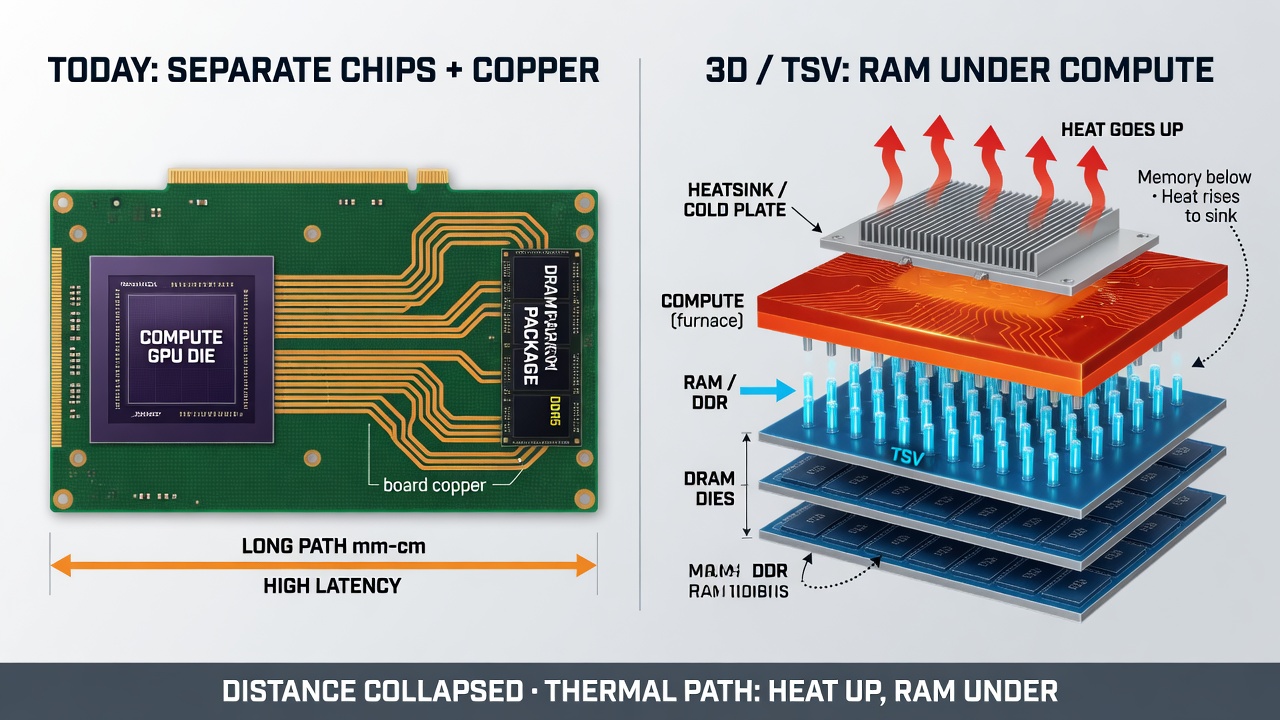
The path we will be held to is not “copy CUDA in the dark.” It is a systems path:
- Distance. HBM is not “RAM but closer.” It is stacked DRAM + TSV + interposer + thermal and yield hell. CXMT climbing toward HBM-class is the mountain, not a vibe. On-package / 3D attach is how you smash the wall: memory married to compute until the die stops shouting across a continent of copper for every weight.
- Heat. Collapse the distance and watts concentrate. Heat is the physics boss. Immersion and two-phase cooling are the industrial path. Cryogenic niches — including LN₂-class sinks — may exist at the tip of the spear if anyone is crazy enough. They are not the product line. Do not let a lab trick become the heading of the claim.
- Fabric. One package is not a civilization. A unified scale-up bus — Huawei’s answer to NVLink versus PCIe for everyone else — is how many near-memory packages become one machine. We already said the bus was the story.
- Energy. Heat is the boss; power plants are the boss of the boss. National halls are megawatt problems before they are SKU problems. A vision that never says electricity is incomplete engineering.
- Compiler. Open weights walk in. They trip on the compiler. The software moat is still CANN / kernels versus CUDA, not the weight file. Hardware halls without a production software stack are museums.
When memory sits near the package, the compute that was always there finally stands up. Not more marketing teraflops. Fewer eternities of waiting. That is the unleashing — if yield, cooling, and megawatts allow it to ship as infrastructure, not as a keynote.
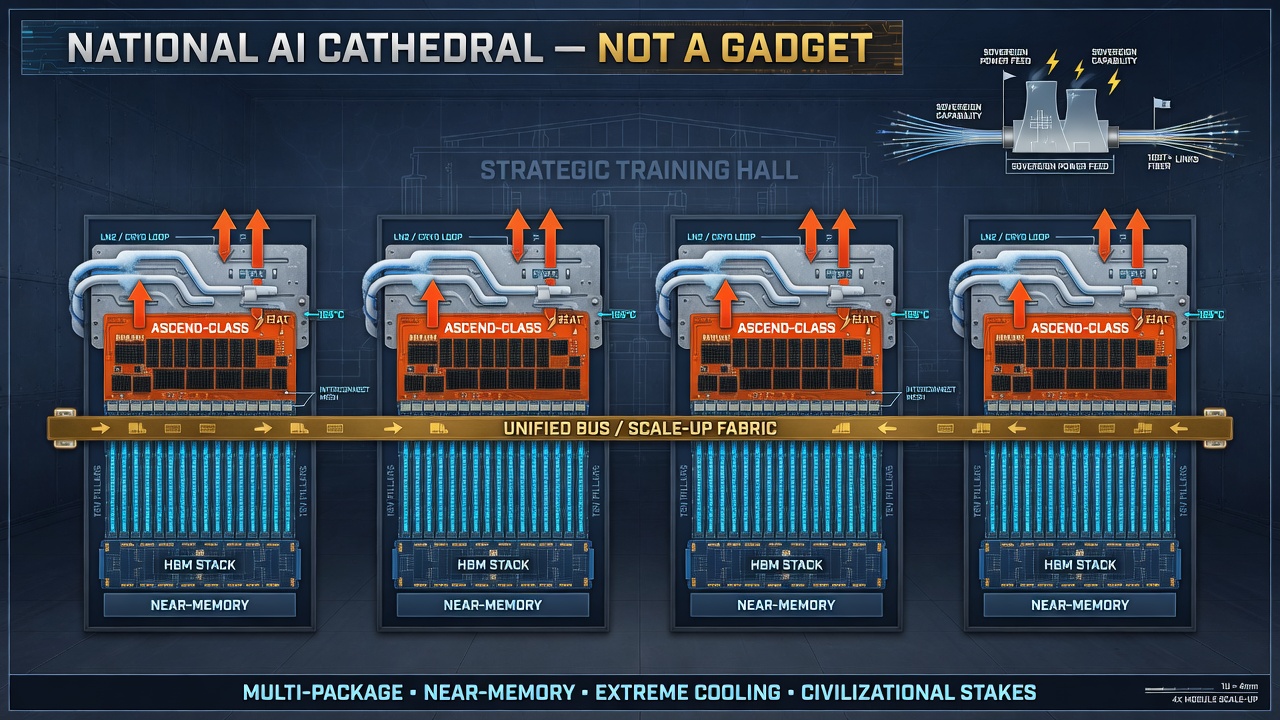
Vast potential is a constellation of those packages, some thermally outrageous on purpose, because the prize is who still trains when the old roadmap is locked outside the gate. China has scaled hard industry before. Here the product is not the next shiny box. It is irrevocable capacity.
V. Receipts, labelled by layer
A receipt only counts for the layer it actually proves.
- Workflow, not silicon: flat-rate GLM coding access from Zhipu’s z.ai/subscribe (recorded August 2026). Chinese frontier models sold as everyday agent / IDE fuel. That is software lock-in and acceptance ahead of a sovereign bill of materials. It does not prove those models sit on domestic accelerators. Keep the bookmark; do not misfile it.
- Bus / stack: DeepSeek returning on Huawei iron — we already wrote that the bus was the story. That is a hardware–software receipt, not a SaaS landing page.
- Memory: the CXMT climb toward HBM-class capacity and yield. Watch that, not the FLOPS slide.
- Package: whether Chinese advanced-packaging houses put 3D / on-package memory into racks you can count, not into a keynote reel.
By 2031 the pairing should be obvious in hindsight: the models were never the hard border. The shopping list was. Open weights walk in; the ban only hurts those who still rent the temple abroad — and those who never built the compiler. Open source weights are the easy on-ramp. The hard border is still the shopping list plus the toolchain.
VI. What we are not claiming
- Not that every laptop in Europe bows to a Chinese sticker.
- Not Christmas gadgets, not a thinner phone, not “China invents physics.”
- Not that dual stacks appear in 2031 — they already have. The claim is sovereignty of the main path.
- Not that liquid nitrogen sits beside every desk. Gadget economics forbid that. AI-race economics may fund a thin, thermally outrageous tier. That is a niche, not the gospel.
VII. Why 3DN writes this down
We do AI engineering in production: agents, caches, utilization charts that confess. The small leak and the national leak are the same physics. So: five years. Dated. Public. Strategic, not retail.
The seal: China’s answer to NVIDIA / ASML denial will be memory-first, 3D-integrated, fabric-scaled systems — cooled like national infrastructure when the megawatts allow it, filled with open weights that already hold a passport, compiled for a domestic stack. Gaming-GPU heritage plus shrink-only holiness is the incomplete gospel. The true power was never missing from the die. It was waiting on the wrong side of the wall, on the wrong shopping list, and on software that still asked permission to exist.
3DN vision, recorded 11 August 2026. Hold us to 11 August 2031.

Leave a Reply